- Magazine Dirt
- Posts
- Strike anywhere
Strike anywhere
Meet the phillumenists.
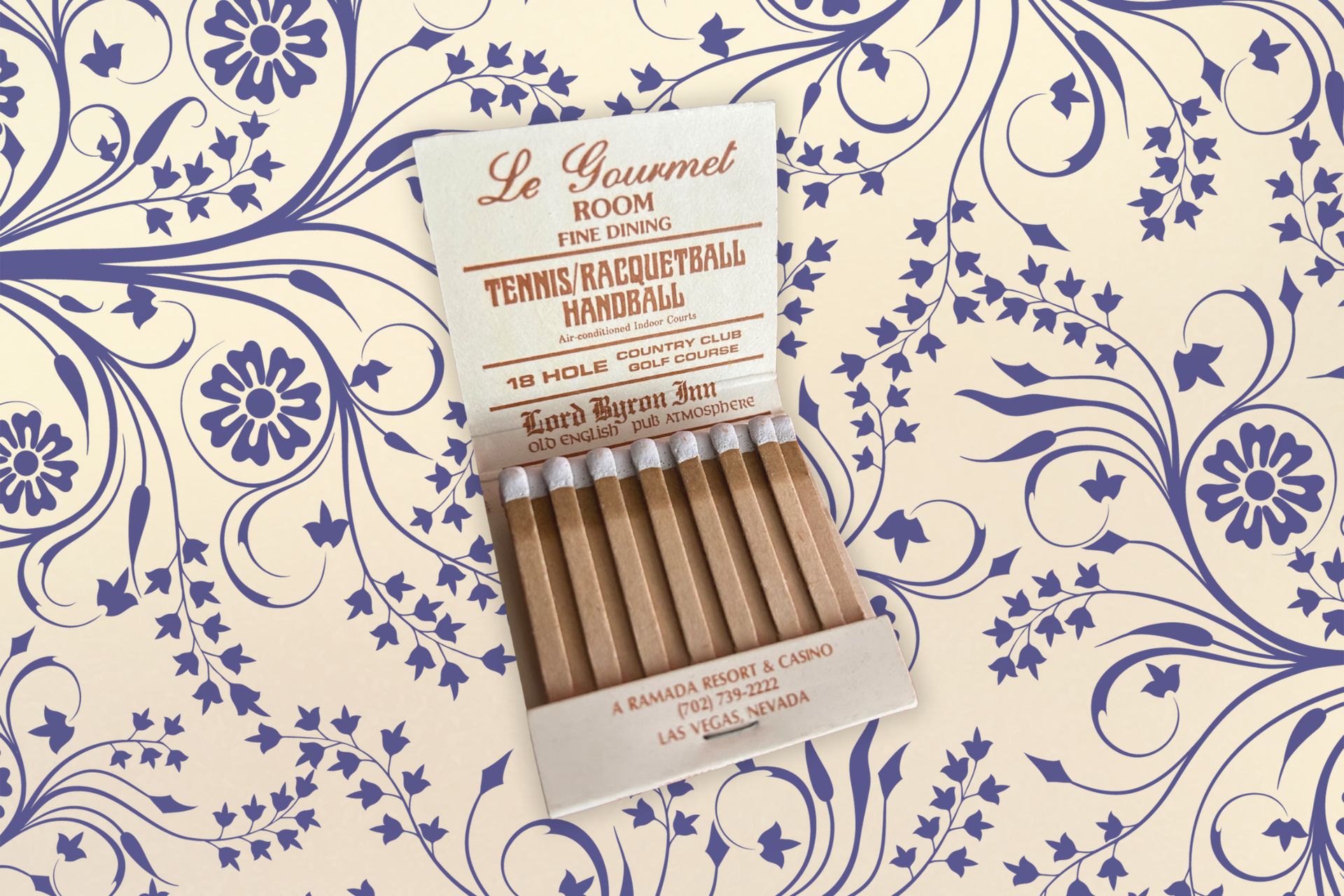
Paula Mejía on matchbooks as memories.
In 2015, a single matchbook quietly traded hands deep in Orange County, California. That innocuous transaction—$6,000 for the matchbook of a 1927 dinner commemorating Charles Lindbergh—broke the Guinness World Record for the most expensive matchbook ever sold.
Matchbooks are unique in the collecting space because, unlike baseball cards and sneakers, memory tends to carry more weight than monetary value here (even if Lindbergh was involved). They aren’t worth much, financially speaking, regardless of whether they function as surviving ephemera of historical events and places no longer in existence. An unstruck Studio 54 matchbook sold on eBay for $149.99.
An unstruck Studio 54 matchbook sold on eBay for $149.99.
Even one of matchbook collecting’s own legendary tomes—200 matchbooks purchased by the Mendelson Opera Company in 1889, embellished with hand-printed stories and photos of the opera’s cast at the time—saw one of its survivors insured for $25,000. That sum can be interpreted as either staggering or a steal depending on who you ask, given that “there are no set values on any of this material,” says Michael Prero, who runs the collector’s site Matchpro. That’s also given way to a culture of swapping matchbooks, in person and by mail to strangers, with little fear of being scammed.
Collecting matchbooks has taken off on Instagram. Some pages document the specific matchbooks you’ll find in one area, like Vancouver or New York City or the Midwest, often against stark white backdrops. Other chroniclers situate the booklets in their place of origin, juxtaposing them against burgers, omakase, and beer and shots combos they’ve purchased, or before the locale’s entryway signs. In one matchbook Instagram group I’m in for Los Angeles-area collectors, members map out their vacations with lists of bars, restaurants, and hotels that still dole them out, and dish about which places have restocked recently.
In one matchbook Instagram group I’m in for Los Angeles-area collectors, members map out their vacations with lists of bars, restaurants, and hotels that still dole them out…
Participation in the professional organization Rathkamp Matchcover Society—the oldest and most centralized club in the U.S. of its kind—peaked around 1985 with 1,900 members, says Prero. The anti-smoking campaigns of the late 1980s decimated business for matchbook manufacturers domestically as places started to carry them less and less. “Augmenting this disaster, the Post Office's continually soaring postage increases have just about killed trading-by-mail between collectors,” he says. “In the late 1980s, I was trading with 125 different collectors. Now I'm down to two.”
Today there's only one such manufacturer still in existence in the U.S., and most production has jumped to Europe and Asia (who prefer matchboxes to matchbooks), Prero notes. But that hasn’t stopped the practice from sticking around anyway. “In case I've made this sound like the hobby is dying out, it's not,” he writes over email. “Even if all match manufacturing ceased today, there are hundreds of millions of matchbooks still out there, waiting to be collected.”
The emergence of ad-hoc hobbyist groups on social media suggests that matchbook collecting hasn’t so much ceased as it has splintered into distinct mechanisms for gathering these tiny totems. Among some fellow phillumenists—the technical term for collectors—there is also an anecdotal sense that there’s a recent uptick in both new and older businesses offering consumers matchbooks.
“Even if all match manufacturing ceased today, there are hundreds of millions of matchbooks still out there, waiting to be collected.”
“A lot of restaurants are actually in the process of getting matches because so many people were asking about them,” says Rex Pham, whose account match_cvr celebrates design while offering a trading mechanism for collectors. “So I think, due to demand, restaurants are much more open to stocking up on keepsakes.” City-specific groups also continue growing. Alice Cavallo, a collector based in Switzerland who started a blog-turned-retailer for matchbook heads to display their wares named Oh, Watch a Match!, says she’s also seen the collecting habit pick up in Europe.
Despite cigarette smoking’s mystique making a slight comeback among younger generations, matchbooks have all but transcended their initial utility—to light a cigarette ablaze. The draw now is for a particular sort of nostalgia: The memory of having grabbed the matchbook itself (though this nostalgia is distinct from participating in small communal gestures afforded by smoking, like sharing a light and surreptitiously pocketing it.)
In LA, a city of diffuse micro-communities not known for an abundance of cigarette smoking, I’ve noticed that a buzzy burger spot on Melrose Avenue opened by Ben Hundreds in 2024, The Benjamin, has different matchbooks for its restaurant and its sister bar located upstairs. Old Hollywood hotels like the Sunset Tower and Chateau Marmont keep their repositories stocked, though sometimes you have to ask. A local concert promoter in town, Sid the Cat, makes custom matchbooks for the artists performing at their various venues.
Old Hollywood hotels like the Sunset Tower and Chateau Marmont keep their repositories stocked, though sometimes you have to ask.
A slice of Etsy is thriving with designers-for-hire ready to create them for one-off occasions, like weddings and shapewear brand product launch parties. There’s a cynical read here—of everything as branding, and the matchbook becoming a more photogenic business card. Or there’s the wholesome view that no personal milestone is too small to merit a custom matchbook, and that the charm of a simple paperboard booklet can pull in groups of strangers to shyly meander up to bars, sharing the physical trove of where their lives have swerved recently. I prefer the romance of the latter.
I’m not sure when I compulsively started slipping matchbooks into my pocket. However, idling by a host stand or a packed bartop for an indeterminate stretch ceased being an exercise in patience and morphed into an opportunity to grab them. I felt pulled to dusty corners of thrift stores, thumbing matchbooks of country clubs and desert hotels I’ll never set foot in.
The little booklets have a place in my apartment (an overflowing bowl) yet they still turn up everywhere, in purses and coat linings, as stubborn as weeds albeit with a prize inside: Not the matches themselves, but rather the compounding of personal histories. The dull matchbook I took from the Peppermill Restaurant in Las Vegas belies how wacky that place is, but it serves as a living emblem of the time we stayed just a touch too long in Sin City. Years ago, when I was single, I handed a matchbook from Pal’s Lounge, a perfect bar in New Orleans, into the hand of someone who I’d been flirting with in London—because inside the front flap, you could write your name and number down. I can’t remember if they called me, but I recall feeling flushed as I pressed it into their palm.
For Valentine’s Day last year, I collaborated with an Etsy artist to surprise my fiancé with matchbooks for the bartop inside our home. Everyone who’s come through our place has pocketed one or two themselves; we’re now overdue for a restock.